
High above the wooded hills of Dalhousie lies Dainkund Peak, a broad, wind-swept meadow often referred to as the Singing Hills.
Visitors come here for open views, shifting clouds, and quiet walks along ridgelines. But for those who live around these hills, Dainkund is also shaped by stories—passed down through recollection, conversation, and belief.
Mountain landscapes have always given rise to folklore.
In places where weather shifts quickly, forests are dense, and distances are long, stories become a way of making sense of the unknown.
Dainkund is no different. Alongside its misty trails and scattered hamlets, it carries oral traditions that speak of fear, faith, and collective resolve.
This is not a tale of conquest, but of how the hill people and communities once understood their surroundings—through stories that travelled as easily as people did across these hills.
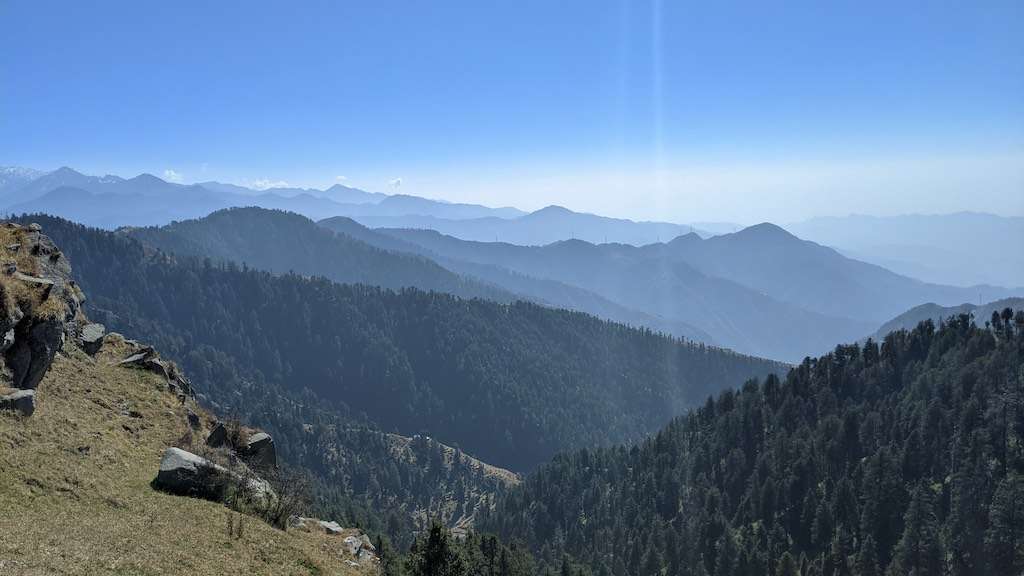
Dainkund and Its Setting
Dainkund lies about 10–12 kilometres from Dalhousie, rising higher than the surrounding hills. From its open slopes, the land falls away in all directions. On clear days, the Dhauladhar range appears close enough to trace, the Chamba valley stretches below, and the plains of Punjab shimmer faintly in the distance.
Having lived in Dalhousie for close to two years, with frequent uphill drives and walks toward Dainkund, the place became familiar to me—not in a way that exhausts it, but in a way that allows its moods to be noticed.
It was during one such visit that I first became curious about the name Dainkund. Like many visitors, I had heard it pronounced casually, without much thought. But place names in the hills often carry meaning, and local usage sometimes preserves older layers of memory.
After several conversations, a shopkeeper on Dainkund offered an explanation rooted in local belief: dain in Hindi refers to a witch, and kund to a pond.

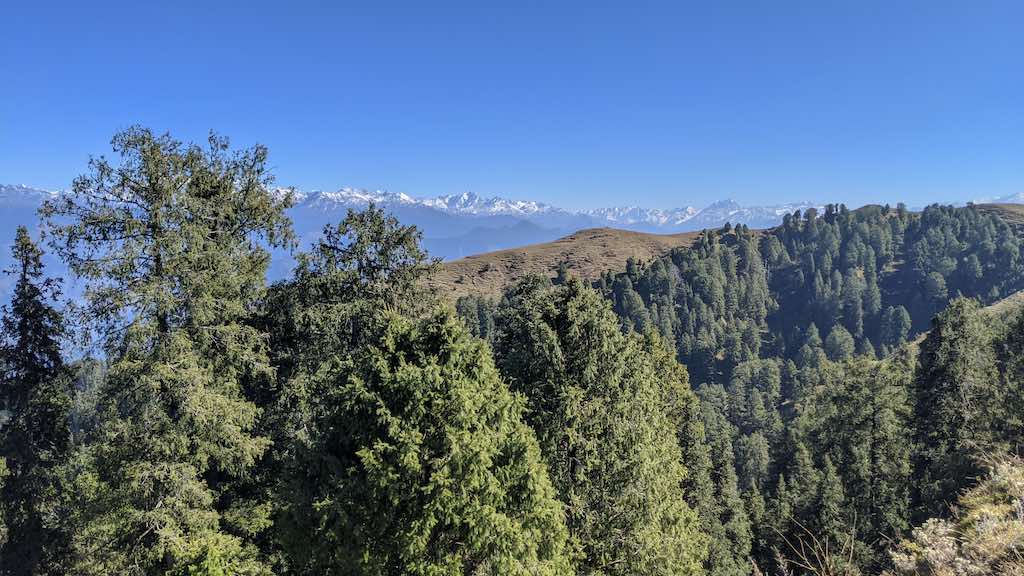

The Folklore of the Pond
According to local folklore, a witch was believed to inhabit a pond in these hills. Her presence made the water unusable, forcing villagers to walk long distances to find alternative sources for their cattle and daily needs. Fear, scarcity, and isolation shaped the way the story unfolded.
Faced with this disruption, villagers are said to have prayed collectively to the forest deity Paoloni Mata, also pronounced Pohlani and Pauloni Mata, seeking protection. In local telling, the Goddess responded by driving away the threat, restoring the pond to the community. From then on, the place came to be known as Dainkund.
The temple of Paoloni Mata lies several kilometres away from Dainkund, separated today by an air force station. The area around the kund itself is not easily accessible, falling within a restricted zone. Only military personnel, shepherds, and local villagers move through these stretches regularly.
(You can read about the Paoloni Mata temple trail )
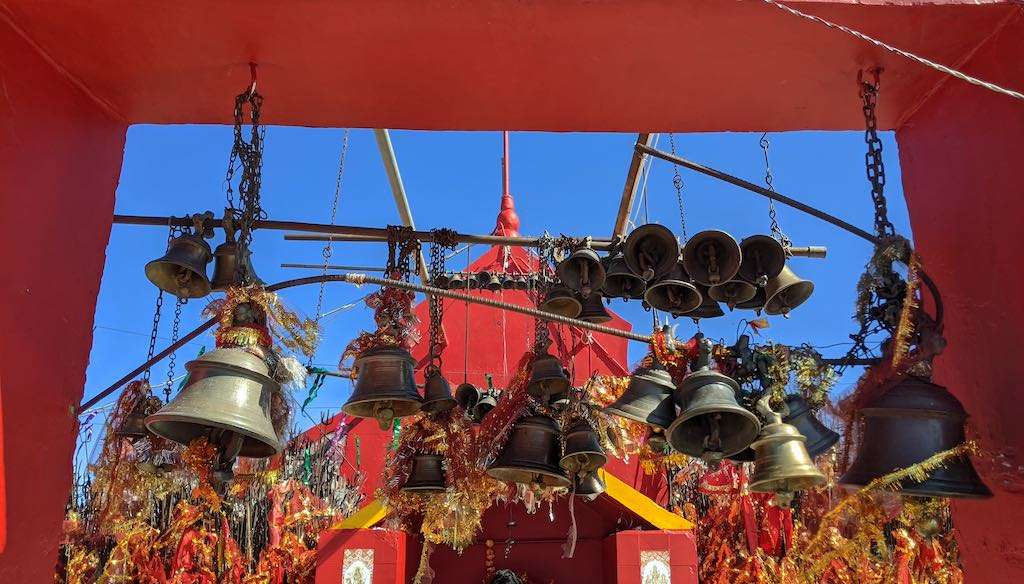

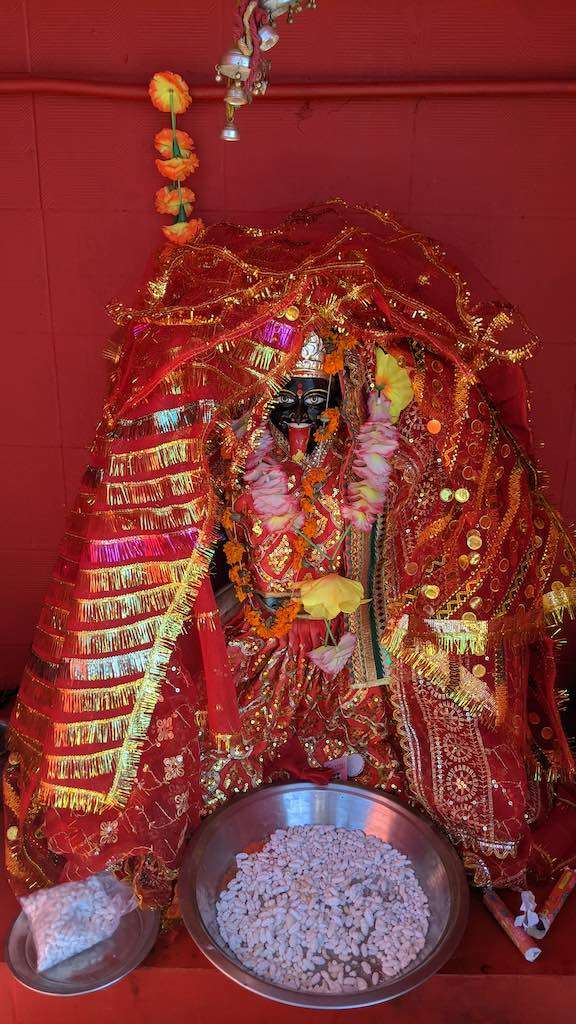
Walking Toward the Kund
On one occasion, after a walk to Paoloni Mata, a small group of us attempted to reach the area associated with the kund. We were advised by locals to return before sunset, as wildlife—including bears and, occasionally, snow leopards, move through these hills.
When we reached the site, the pond itself was dry. Perhaps it fills during the monsoon months. What remained striking, however, was the landscape around it—open, undisturbed, and carpeted with white wildflowers that, from a distance, resembled a spread of snow.
As evening settled in, the light shifted. The rocks and tree trunks took on a warm crimson hue, and far below, the waters of the Ravi reflected the fading sun. The plains appeared briefly, softened by distance and dusk. The entire scene felt suspended and surreal, held between daylight and night.

The entire landscape looked surreal in saffron.

The waters of the River Ravi flowing across the plains of Punjab were glittering and its banks could be vaguely seen under the twilight.


Folklore, Fear, and Memory
We did not photograph the pond.
Whether this was due to caution, instinct, or simply because our attention was elsewhere is difficult to say. What remained more vivid than the folklore itself was the landscape—the colour of the sky, the quietness of the hills, and the way the day ended without urgency.
Stories like these endure not because they are meant to be proven, but because they once helped people live with uncertainty. In the high meadows of Dainkund, folklore becomes another layer of the landscape that’s woven into how the hills are named, walked, and remembered.
Even today, the Singing Hills hold space for both openness and silence. And perhaps that is why such stories still find a place here.

Closing Reflection
Perhaps it is these stories—quietly held and rarely questioned, which have kept Dainkund Peak largely untouched. The hills remain open, clean, and unhurried, shaped more by weather and walking than by crowds. There is a sense that the folklore itself has acted as a kind of boundary, allowing the landscape to retain its stillness.
As we turned back toward our base that evening, there was no feeling of having uncovered or conquered anything. Instead, there was a quiet satisfaction in having spent time with the hills as they are—without trying to explain them away.
If these high meadows, once associated with fear and mystery, can feel so calm and luminous, one wonders how the paths shaped by faith and everyday goodness might unfold.
That story lies along another walk—one that moves gently across the Singing Hills, not in search of answers, but simply to remain with the landscape a little longer.
(You can read more about the Singing Hills in The Enchanting Trek Across Dainkund)
This piece is part of a wider body of writing on Dalhousie and its surrounding hills. And, I hope this photo-led walk through Dalhousie offers a sense of the town beyond a single season, and helps you arrive with curiosity rather than expectations.

We had a ghost encounter here too. Saw 2 witches 10/10 would recommend!
Beautiful pictures and folklore also. Nicely penned. I have a wish to visit this hill station. Thanks
Hope you get to visit it soon. Much thanks for reading !
Informative and well explained..
Pingback: Enchanting trek across DK - Polkajunction
Pingback: Never Ending Musical Notes of the Singing Hills - Polkajunction
Those are some stunning captures! I love that you visited the place, else you would have missed out on all the gorgeousness! Thanks for sharing it with us:)
beautiful pictures – lovely folklore.
This place looks like something out of a movie – it’s so pretty. I loved the witch’s story. It seems she was camera shy
Debbie
Wow! Stunning pictures. I have never been to this place, nor have I heard of it. Maybe someday, I will visit the place. It looks magical.
The folklore is fascinating! I am enjoying this series on Incredible India, so many places to visit!
Mother nature is indeed beautiful and makes you feel wow..Pictures are really nice
Mesmerizing pictures ! The folklore makes the place more enchanting and even I want to visit now ?