
The Taj Mahal is often described as a monument of love. Yet beyond its romantic associations lies a masterpiece of architectural precision, geometry and symbolism that continues to fascinate historians, architects and travellers alike.
In the pre-pandemic years, nearly seven to eight million visitors passed through its gates annually — placing it alongside global icons such as the Eiffel Tower and even the stately avenues of Saint Petersburg in Russia in terms of footfall.
But what truly draws people here is not merely its story, but its design.
In this guide, we explore 20 interesting facts about the Taj Mahal — from its architectural features and engineering brilliance to the myths, materials and historical nuances that make it one of the most studied monuments in the world.

Key Architectural Features of the Taj Mahal
Before exploring the detailed facts, here is a quick overview of the architectural features that define the Taj Mahal:
• Constructed entirely from white Makrana marble that subtly changes hue through the day.
• Designed with near-perfect bilateral symmetry along its central axis.
• Flanked by four minarets, each built with a slight outward tilt for structural safety.
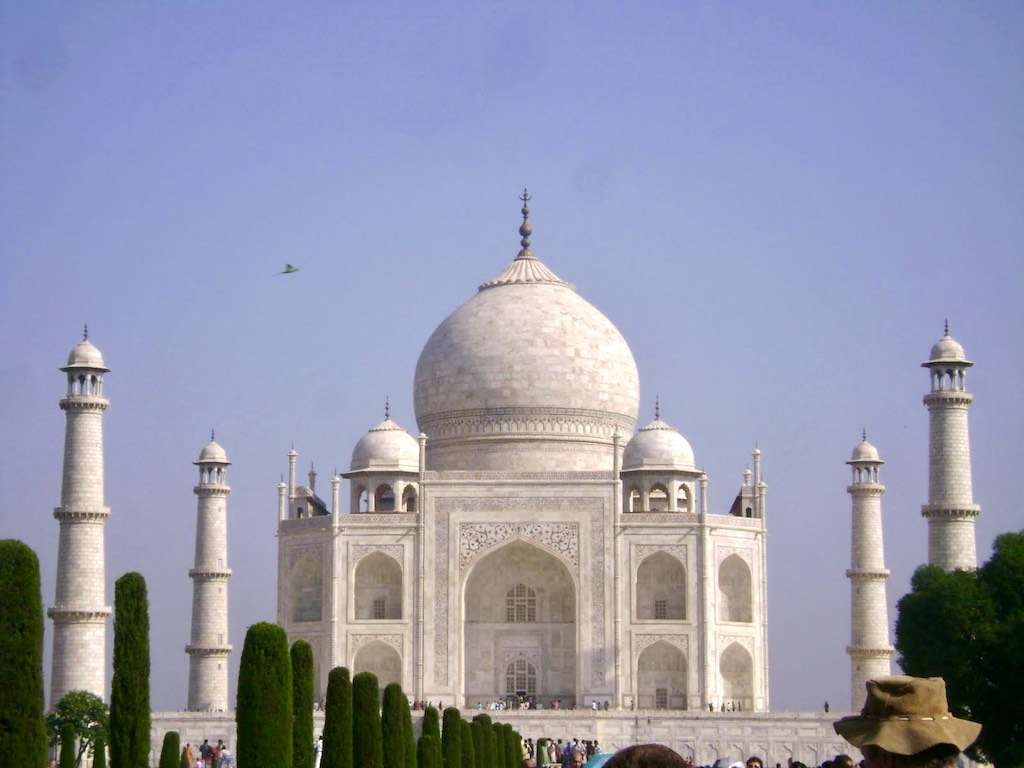
• Crowned by a massive central onion dome rising approximately 35 metres.
• Adorned with intricate pietra dura inlay using semi-precious stones.
• Inscribed with Quranic calligraphy that increases in size higher up — an optical correction technique.
• Laid out within a Persian-inspired Charbagh garden symbolising paradise.
• Accompanied by a mosque and a jawab (mirror structure) to preserve visual balance.
• Elevated on a marble plinth overlooking the Yamuna river.

20 Interesting Facts About the Taj Mahal
Monuments have always fascinated me — especially the way stone, arches and silent corridors seem to hold centuries of memory. The Taj Mahal is no exception.
Across multiple visits, I found myself noticing details that are easy to miss at first glance. Some were pointed out by local guides, others emerged from historical reading, and a few revealed themselves only through slow observation.
What follows are 20 interesting facts about the Taj Mahal — drawn from its architecture, construction techniques, historical context and the myths that continue to surround it.
1. Shah Jahan and the Making of the Taj Mahal
The Taj Mahal was commissioned by the Mughal emperor Shah Jahan, who was known as Prince Khurram before ascending the throne. He envisioned it as a mausoleum for his wife Arjumand Banu Begum, remembered more widely as Mumtaz Mahal.
Mumtaz Mahal was his third wife, and she died in 1631 while giving birth to their fourteenth child in Burhanpur, in present-day Madhya Pradesh. Her death deeply affected Shah Jahan, and it was in her memory that the Taj Mahal began to take shape — not merely as a tomb, but as a carefully planned architectural statement.
2. The Makrana Marble of the Taj Mahal
Construction of the Taj Mahal began in 1632 CE and was largely completed by 1648 CE, with finishing work continuing for a few more years. Historical accounts suggest that nearly 20,000 artisans and labourers worked on the complex over a span of about 22 years.
The luminous white marble used for the mausoleum was sourced from Makrana in Rajasthan — a region long renowned for its high-quality marble. It is this Makrana marble that gives the Taj Mahal its distinctive milky sheen, subtly shifting in tone with changing light throughout the day.

3. The Architectural Style of the Taj Mahal Is Not Purely Islamic
The Taj Mahal is widely described as an example of Indo-Islamic architecture, blending Persian, Mughal and Indian design traditions.
While its symmetrical layout and grand dome reflect Persian influences, several elements draw from indigenous Indian architectural vocabulary. The lotus motif crowning the main dome, the use of chhatris (domed pavilions), and decorative brackets echo earlier Rajput and regional design traditions.
The result is not a purely Islamic structure, but a carefully synthesised architectural form — one that reflects the cultural and artistic exchanges of 17th-century India.
4. Who Designed the Taj Mahal?
The Taj Mahal was commissioned by Emperor Shah Jahan, but its architectural design is widely attributed to Ustad Ahmad Lahouri, a Persian architect believed to have led the project.
Some historical accounts also mention Ustad Isa — often identified as Ustad Isa Sherazi — as having played a role in the design process. However, the exact extent of his involvement remains a matter of scholarly debate, as documentation from the period does not provide complete clarity.
On the other hand, like most monumental works of the medieval world, the Taj was not the creation of a single individual. Historical records indicate that nearly 20,000 craftsmen, artisans and labourers were involved in its construction. These included stone carvers, calligraphers, dome specialists, inlay artists and engineers drawn from different regions of the Indian subcontinent.
While imperial chronicles tend to foreground court-appointed architects, the visible presence of Rajput architectural elements — such as chhatris, lotus motifs, and indigenous decorative brackets — strongly suggests that local Hindu craftsmen played a significant role in shaping the monument’s final form. Many of their individual names were not systematically recorded in Mughal documentation, but their artistic vocabulary remains embedded in the structure itself.
The Taj Mahal, therefore, stands not only as an imperial commission, but as a collaborative architectural achievement shaped by multiple cultural and regional influences.


5. The Taj Mahal Refined an Earlier Mughal Prototype
Contrary to popular belief, the Taj Mahal was not an entirely unprecedented architectural creation. Its design evolved from earlier Mughal royal mausoleums — most notably Humayun’s Tomb in Delhi, constructed nearly 85 years before the Taj.
If Humayun’s Tomb established the Mughal template for imperial mausoleums, the Taj Mahal perfected it — both in architectural balance and landscaped design.
The charbagh garden layout, elevated plinth, central dome and symmetrical composition were already visible in Humayun’s Tomb. However, what distinguishes the Taj Mahal is the refinement of proportion, the precision of symmetry and the harmonious integration of marble and sandstone.

6. The Taj Mahal Is More Than Its White Mausoleum
The Taj Mahal complex extends across approximately 55 acres, with the white marble mausoleum positioned at the northern end, overlooking the Yamuna River.
The approach to the mausoleum is deliberate and ceremonial. Visitors enter through monumental gateways into the Jilaukhana — a forecourt that prepares the visual axis toward the Charbagh gardens. These Persian-inspired quadrilateral gardens divide the landscape into four symmetrical lawns, reinforcing the monument’s geometric precision.
Red sandstone structures — including the mosque and the jawab — frame the marble mausoleum, balancing colour, scale and visual rhythm. Across the river lies Mehtab Bagh, the so-called “Moonlight Garden,” historically aligned with the Taj’s axial symmetry.
The Taj Mahal, therefore, was conceived not merely as a tomb, but as an orchestrated spatial experience.
7. The Often Overlooked Red Sandstone Structures
On my recent visit, I resisted focusing solely on the white marble mausoleum and instead spent time exploring the surrounding red sandstone structures.
These buildings — particularly the mosque to the west and the jawab to the east — provide both architectural balance and material contrast. Their warm tones heighten the luminosity of the marble mausoleum, while their domes and arches reinforce the Indo-Islamic aesthetic vocabulary of the complex.
The sandstone structures also reveal the layered craftsmanship behind the monument — local masonry traditions, imperial design principles, and devotional spaces that have witnessed centuries of prayer and pilgrimage.
Before the marble dome even comes into full view, it is these red corridors and arcades that first frame the visitor’s experience.


8. A striking trivia on the domes of the Taj
The main gateway to the Taj Mahal — the grand Darwaza — is built in red sandstone with delicate marble inlay. Mughal aesthetics are visible in its calligraphy, arches and geometric ceilings.
Along the top of this gateway are 22 small domed chhatris. A popular belief says that these 22 domes represent the 22 years it took to build the Taj Mahal. Some even say that one dome was added each year to mark the progress of construction.
Whether symbolic or coincidental, these domes quietly crown the gateway that frames the first breathtaking view of the Taj.
And truly, that first glimpse through the arch never gets old.


9. Optical illusion in the Taj’s calligraphy
If you look closely at the Quranic inscriptions framing the main gateway and the mausoleum, you may notice something intriguing.
The calligraphy appears perfectly uniform in size from the ground. But in reality, the letters gradually increase in scale as they move higher up the structure.
The calligraphy appears uniform from ground level, but closer observation reveals that the script increases in size higher up — probably an architectural technique incorporated by the designers of the monument, to maintain visual proportion when viewed from below.
As a result, from below, the calligraphy looks evenly sized and balanced.
It is one of those quiet details that most visitors miss — yet it speaks volumes about the aesthetic intelligence behind the Taj Mahal’s design.

10. The heartwarming facilities of a bygone era at the Taj
The Taj Mahal complex was never meant to be just a solitary marble tomb. The surrounding high walls and long corridors once accommodated workers, attendants and visitors during the early years after its completion.
Today, these shaded arcades offer much-needed respite from Agra’s heat, allowing visitors to pause before stepping back into the glare of white marble.
The Jawab — the red sandstone structure to the east of the mausoleum — stands opposite the mosque to maintain symmetry. Though not used for prayer, it has long been associated with receiving guests and dignitaries who came to admire the monument.
To the right of the main gateway lies what is believed to have once been a cookhouse, a reminder that the Taj functioned as a living complex, not merely a static monument.
Even now, as millions walk through its gates, one can sense that this place was designed not just for remembrance — but for movement, gathering and experience.


11. Taj Mahal’s well-kept secret
The white marble mausoleum of the Taj, with its characteristic Islamic pishtaq, is known as the Rauza-i-Munawwara. It houses the tombs of both Shah Jahan and Mumtaz Mahal.
However, what visitors see inside are ornate cenotaphs — beautifully carved and inlaid replicas. The actual graves lie in a lower chamber directly beneath them, in a more austere setting.
Within the larger complex are also the graves of Shah Jahan’s other wives and a few attendants, reminding us that the Taj was not an isolated memorial but part of a broader funerary tradition.
12. The functioning mosque within the Taj complex
The marble mausoleum is flanked by two red sandstone structures.
To the west stands the masjid, the functioning mosque. To the east is the jawab, built primarily to maintain the perfect symmetry so characteristic of Mughal architecture.
While both structures appear nearly identical from the outside, their purpose differs — the mosque faces Mecca and is used for congregational prayers, whereas the jawab serves as a structural and visual counterbalance.
13. The striking prayer mats of the Taj Mahal
Inside the mosque, the black marble flooring is inlaid with outlines resembling prayer mats — said to number 569 — marking individual spaces for worshippers.
Even today, the mosque comes alive on Fridays when local devotees gather for prayers. On that day, the Taj Mahal remains closed to tourists, except for those attending the mosque.


14. An astounding fact about the fountains of the Taj complex
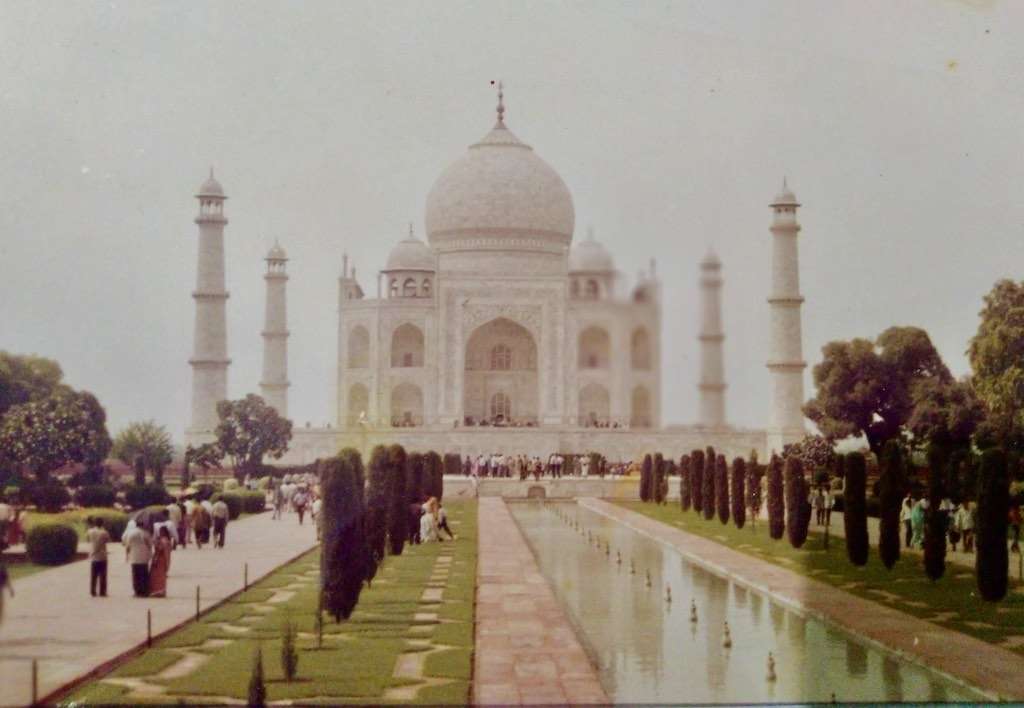
As you walk along the central axis from the main gateway toward the white marble mausoleum, you pass the long reflecting pool lined with fountains — one of the most photographed views of the Taj Mahal.
The fountains are often said to be connected to the Yamuna River, which flows just beyond the monument. According to guides, the river’s flow once influenced the water system of the complex. In reality, the Mughal engineers had devised an elaborate hydraulic mechanism using underground tanks and gravity-fed copper pipes to ensure an even water level across the fountains.
The Charbagh gardens surrounding the water channels were originally laid out in the Persian style, symbolising paradise. During the British colonial period, however, the gardens were re-landscaped to resemble formal English lawns, altering their original aesthetic while retaining the geometric layout.
15. The Taj’s “Black” Counterpart
Did you know that there is a long-standing legend about a Black Taj Mahal?
Across the Yamuna River, in the Mehtab Bagh area opposite the Taj, dark stone remnants were once believed to be the foundation of a proposed black marble mausoleum — supposedly conceptualised by Shah Jahan for himself.
According to popular lore, he intended to build his own tomb in black marble, directly facing the white Taj Mahal, connected by a bridge across the river.
However, modern archaeological studies suggest that the so-called “black marble” stones were likely discoloured white marble fragments, and there is no conclusive evidence that a separate Black Taj was ever formally commissioned.
Before any such structure could take shape, Shah Jahan was imprisoned by his son Aurangzeb and confined to the Agra Fort — from where he is said to have spent his final years gazing at the Taj Mahal from a distance. Upon his death, he was buried beside Mumtaz Mahal inside the mausoleum.
On days when the Yamuna runs full after heavy rain, the river still forms a dramatic backdrop to the monument — a reminder of how carefully the Taj was positioned within its landscape.
If you look closely across the river or from within Agra Fort itself, you may catch a striking perspective of the Taj. It is from Agra Fort, in fact, that Shah Jahan is believed to have viewed the monument during his imprisonment.
If you are planning your visit, you might consider including Agra Fort in your itinerary — many curated heritage tours combine both sites for a deeper understanding of the Mughal narrative.
16. The Not-So-Lucky Shah Jahan
One lesser-known detail about the Taj Mahal’s story is that Shah Jahan is believed to have spent his final years viewing the monument from a distance.
In 1658, not long after the completion of the Taj Mahal complex, Aurangzeb deposed and imprisoned his father during a struggle for the Mughal throne. Shah Jahan was confined to the Agra Fort, from where tradition holds that he could see the Taj Mahal across the Yamuna River.
It is widely believed that he spent his remaining years gazing at the mausoleum of Mumtaz Mahal from a marble pavilion within the fort — a poignant image that has since become part of the Taj’s enduring narrative.
There are also stories of a secret tunnel connecting the Agra Fort to the Taj Mahal, suggesting that Shah Jahan may have visited the mausoleum discreetly. However, these accounts remain part of local lore rather than firmly established historical record.
When he died in 1666, Shah Jahan was laid to rest beside Mumtaz Mahal inside the Taj — the only asymmetrical element within a monument otherwise defined by perfect balance.

17. The only asymmetry in the Taj Mahal
The Taj Mahal is celebrated for its near-perfect symmetry. From the gardens to the minarets, from the mosque to the jawab — everything aligns along a precise central axis.
Yet, there is one noticeable exception.
Inside the mausoleum, the cenotaph of Mumtaz Mahal lies at the exact centre of the chamber. Shah Jahan’s cenotaph, however, was added later — slightly offset beside hers.
This makes it the only element within the entire complex that breaks the monument’s otherwise flawless symmetry.
Originally, the Taj was conceived as a resting place for Mumtaz alone. Shah Jahan’s burial beside her altered the perfect balance — but in doing so, it also completed the story.
18. Intriguing fact about the doors inside the Taj complex
The many doors within the Taj Mahal complex have long sparked curiosity.
Some of them remain sealed, giving rise to speculation about hidden chambers and forgotten passages. One popular belief suggests that a closed doorway may once have led to a tunnel connecting the Taj Mahal to the Agra Fort. Whether such a passage truly existed or not remains uncertain, but the idea continues to fascinate visitors.
Several doors today remain shut, while a few are used for storage, especially during festival preparations such as Eid.
To the right of the main Darwaza, there is also a lesser-known entry point that is believed to have once allowed animal carts to bring in marble and sandstone during the years of construction.
The Taj Mahal may appear serene and complete today, but its layered spaces hint at a far more functional past.
19. Visit the wondrous counterpart of the Taj Mahal
If the Taj fascinates you, then Bibi-ka-Maqbara in Aurangabad is worth a visit. Often called the “mini Taj,” it was built by Aurangzeb in memory of his first wife, Dilras Banu Begum.
The resemblance in layout and dome structure is unmistakable, though the detailing and scale are far more restrained than the monument in Agra.
Aurangzeb, of course, had more than one wife — which makes the gesture all the more interesting. History, after all, is rarely as simple as the marble narratives we inherit.
20. The Taj Mahal receives a royal kind of protection
Few realise that the Taj Mahal has, at times, been physically shielded during periods of conflict.
During World War II, and later during the wars India fought with Pakistan and China, protective scaffolding and camouflage were erected around the monument to guard it against potential aerial attacks.
Such measures underline the symbolic and cultural importance of the Taj Mahal — not merely as a tourist attraction, but as a national architectural treasure.
Even in times of uncertainty, the monument has been carefully protected.


Have you heard these alternative claims about the Taj Mahal?
Like many monuments from the Mughal era, the Taj Mahal has not been free from controversy. Some have argued that it may have been constructed over a pre-existing Hindu structure.
However, mainstream archaeological and historical research has not produced conclusive evidence to support this claim. The monument’s documented construction during Shah Jahan’s reign is supported by contemporary Mughal records and architectural continuity.
That said, debates around medieval monuments in India continue to surface from time to time — reflecting how deeply history and identity remain intertwined in public memory.
Regardless of these discussions, the Taj Mahal at Agra stands today as one of India’s most recognised architectural achievements.
Taj Mahal travel tips and suggestions
- Visit the Taj Mahal in the morning to avoid heavy crowds. And, I mean early morning, as it opens to the public 30 mins prior to sunrise every day barring the Fridays. Visit the official website for further details as well for entry fees.
- You can either physically buy tickets at the counters or book them online
- The Taj Mahal complex has three entry points or gates. I suggest, you avoid the south gate, as it opens late, and sometimes owing to the footfall may also be closed for entry.
- The east gate would be my recommendation, as it has got ticket counters and visitor amenities at the Shilp Gram, located at a walkable distance of around 500metres from the Taj Mahal monument.
- Either opt for authorised tour guides or official Incredible India audio guides
- Night viewing of Taj Mahal is available on five days in a month i.e. on full moon night, as well as two nights before and two nights after the full moon night. And, the timings for the same are 8:30 pm to 12:30 am.
- You might want to read more about the Night viewing experience of the Taj.

Explore Agra Through Curated Guided Tours
Extend Your Journey Beyond Agra
If you are travelling through Rajasthan or planning a longer North India itinerary, you could combine your Taj Mahal visit with a wildlife experience at Sariska Tiger Reserve.
You may also explore Alwar — one of the oldest regions in India — known for its forts, stepwells and layered history.
The Taj may be the highlight — but the surrounding regions hold stories of their own.
Some interesting facts beyond the Taj
It is true that many travellers land in India with the Taj Mahal at the very top of their list. Others dream of “God’s Own Country,” Kerala, and the magic of a live Kathakali performance.
And rightly so.
The Taj Mahal has few parallels in the world. But an ancient civilisation like Bharat has always been far more layered than a single monument.
Beyond Delhi and Agra lie temple towns, rock-cut caves, sculptural marvels and architectural traditions that travelled across South-East Asia centuries ago.
If you linger a little longer, India begins to unfold differently.
Did you know these facts about Indian monuments?
• The Brihadisvara temple at Gangaikondacholapuram is nearly a thousand years old — a towering example of Chola architectural brilliance.
• The sacred spaces of Darasuram temple are adorned with thousands of intricate micro-carvings and rare sculptural panels.
• The quiet hill town of Dalhousie once inspired writers and thinkers who sought retreat in its misty silence.
• The Chhatrapati Shivaji Maharaj International Airport in Mumbai houses one of the world’s largest airport art museums.
These are only glimpses — reminders that the Taj is part of a much wider architectural and cultural landscape.
So perhaps, when planning your next journey, allow India a little more time.

Thoughts on the Taj Mahal and its brilliant architecture
The first time I stood before the Taj, I was spellbound.
It looked almost unreal — like a delicate piece of milk chocolate guarded by deeper brown sandstone on either side. An odd comparison, perhaps, but that was my first impression years ago.
As I walked closer, the marble seemed paler, tinged faintly yellow. Pollution, sadly, leaves its mark even on monuments meant to outlast centuries.
What fascinates me most is how the Taj reveals itself differently with each visit.
The first time, we see it as tourists — overwhelmed and hurried.
The second time, perhaps, as travellers — more attentive.
By the third, we begin to observe.
By the fourth, we start asking questions.
And somewhere along the way, we begin noticing details — symmetry, calligraphy, proportions, stories hidden in stone.
And that is how lists of interesting facts are born.


Planning my next trip to the Taj… already!
I am still yet to experience the Taj Mahal at dawn or dusk — somehow, I always seem to arrive around 10 AM.
Even on my latest visit, the heat was relentless, and much of the complex remained unexplored. And yes, I am still yearning to witness the Taj on a full moon night.
Each visit reveals something new — a shift in light, a forgotten detail, a subtle proportion one hadn’t noticed before.
I hope this write-up on the interesting facts and architectural features of the Taj Mahal added a few fresh perspectives to your own understanding of the monument.
If you’ve visited the Taj, I’d love to hear about your experience. Did it leave you spellbound? Or did it surprise you in ways you didn’t expect?
Until next time — Ciao!

Pin this article for a later read!


You’ve done a fantastic job. It was really informative. Your website is very helpful. After reading this amazing post I am as well happy to share my with friends.
Nice coverage of the place, Very informative blog and suggestion for travelers. I really like to this blog its very interesting and informative. Thanks for your amazing travel guide and your photos are mind-blowing.
Really interesting post. I have been there a couple of years back and I too spent some time walking around the red sandstone structures. I guess I go up to level 3 as an explorer or 4 historian in some places in the first visit. My family always has to pull me out of my exploring/ reading/ reverie as I tend to lost track of time lol.
Really lovely new perspectives of the Taj, would love to visit one day! I can see why you’ve visited several times. I imagine each visit you can see it in a different way.
I had been to Taj a year back. But it appeared far more beautiful from your lens Meenkashi. Truly different!
Thank you, Anagha… Honestly, photos cannot do justice to this wonderful monument 🙂
Such beautiful images. I haven’t been to the Taj. But, wish to be there.. and these images are inspiring me to visit
I’m reading this part of Taj for first time. Definitely, a different perspective of Taj. It is very well written with beautiful pictures.
Thanks for sharing 🙂
Lovely read! Power of the attraction is often misleading when the source is misplaced! 😊
Very nice written …
Such a lovely perspective Meenakshi! Loved your captures ( especially the corridors and the doors) It is so so true that the Taj is. It just white and it’s the whole blend of red and white that makes it so unique and majestic!
Thanks a ton for dropping by Divs….
I have been to TAJ umpteen number of times as there is simply something so awe inspiring about this monument!! I love visiting it a lot but I think I have never paid any attention to the rest of the building around it and your post made me realise what all I have missed there – next time this is definitely on the cards to explore.
I have also been planning to but never made it for the full moon sighting of the Taj yet!
Thank you…and we should explore the complex on a full moon day,soon!
I have been to TAJ umpteen number of times as there is simply something so awe inspiring about this monument!! I love visiting it a lot but I think I have never paid any attention to the rest of the building around it and your post made me realise what all I have missed there – next time this is definitely on the cards to explore.
I have also been planning to but never made it for the full moon sighting of the Taj yet!
I drive to Agra, whenever I feel like. I am in awe of Taj Mahal. I don’t know why! And everytime I visit there, it’s just like a new place to me. You have captured all the aspects of the Taj beautifully! Well done!
Thank you so much for dropping by my blog Sushmita 🙂
Visit to Taj Mahal remains one of my most cherished memories. Thank you for rekindling those images. Nice clicks. Superb write-up.
Glad that you liked the write-up…Much thanks 🙂
Very well written post, I have never been to the Taj, But after reading this I am excited to atlest visit the monumnet atleast once. Super like the photography !
Glad that you liked the pics Masoom…and thanks a ton for dropping by 🙂
Amazing and superb pics of wonders of the world. I have visited this destination.
Thank you 🙂
All I remember from my first visit to Taj is the tonga ride! And the second trip happened in the month of June so you can imagine how fun that must have been. NOT. I enjoyed going through your post more than my actual trip. I guess third time will be the charm if I visit Taj in winters. 🙂
haha..I agree that it can get really tiresome visiting the Taj under a scorching sun! Yes, I guess winters will be the perfect time..Happy travels 🙂
Your pictures have very effectively captured how majestic Taj Mahal is. I couldn’t help but scroll up and down this post to keep having a relook at them.
Much thanks Anu…I am so glad that you liked the pics 🙂
Never been to Agra. Your images were so good that I felt as if I visited the place.
Thank you and you should visit the place at least once 🙂
Have been to this place and its mesmerising ..but this beautiful post makes me fall in love with this place again..thanks for the visual tour.
Much thanks Anubhuti…. 🙂
Wow, These pictures pushing me to explore The Taj Mahal once again. I’ve visited here 2 yr back Indeed it’s the Wonder of world
Haha…..thanks a ton Bushra 🙂
Loved your post, I had visited Tajmahal when I was a kid but after reading your post, I realized its time to visit again. Thanks for sharing the interesting details
Neha (Sharingourexperiences)
Thanks a ton Neha 🙂
Taj Mahal has a different charm of its own. You can go there numerous times and every time you will find something new to enjoy and take back as memories.
Indeed….thanks for dropping by Geethica 🙂
This one is on my to-visit list. We are so used to seeing couple photos in front of Taj Mahal, I quite enjoyed your unique perspective.
Haha….Thanks much 🙂
I would say, what a majestic post… Loved reading it and the photographs are just awesome that make the post even more attractive. Thank you for sharing!!
You had been 5 times to this majestic creation and I’ve not had a luck yet to visit this once 🙁
But will soon visit it…
Ayyo….you should at least once! BTW much thanks for your kind words 🙂
Amazing photography, being born in Agra Taj is the best hang out place for me & friends. I have love & hate relationship with this place but seeing it from your eyes is definitely a refresher.
Taj Mahal never fails to mesmerize- loved your post
I haven’t been there. But your description and pics virtually took me there. One of the best descriptions of Taj I have read so far. And it’s my wish too to visit on a full moon day. It would look magnificent nah?
I wonder what will your 6th visit to Taj will make you? 😀
First of all superb clicks and I’m born n bought up in UP but still not seen this beauty …have to visit for sure
Thanks for sharing so much more around the Taj Mahal, I did not know about the tunnel part at all
Beautiful pics. You reminded me of our Agra trip last year. It is worth a visit for everyone.
Living in such a close proximity to Delhi, I have lost count of the number of times we have visited Taj Mahal. Your post had such intricate details of monuments around Taj, the labyrinth of doors and corridors. Loved reading it Meenakshi. Taj would not have been a marvel in isolation if the beauty around it had not supplemented its existence.
what a gorgeous article!! Loved the pictyres & the narration!! what a lovely art of telling the tale.
I liked your analogy of white chocolate and brown choco chunks ..:) Even though I have visited Taj Mahal but looking at it through your lens was a different experience. And the pictures were like icing on the cake.
I haven’t been here but the pics look lovely and your take on it was enlightening. Sigh… add to bucket list
Lovely perspective! Most people just focus on Taj Mahal but you tried to show it from a different side. Loved last three door pictures.
Beautiful photos you have clicked. I was tiny when i visited Taj and almost have no memmory of it. It’s weird how people don’t give importance to the other side!
Brilliant exhaustive post. we just visited here last year and it brought in some very happy memories going through all the beautiful pics
Thanks for some unknown facts and showing unseen side of taj.
Those are amazing snaps!
You are right about being mesmerised by the Taj. I too have visited this monument at different times in my life – once as a teenager, once with family and once as a mom with my kids and once as a real tourist with a firang. Each time the experience was naturally different but each time you look at it differently.
Lovely description and I liked it that you focused on surrounding monuments as well. I am yet to visit Taj, but your description has certainly piqued my interest a bit more.
Your post made justification to reveal the beauty of Taj from a different prespective. Amazingly beautiful clicks. I was also stunned by its beauty when we visited it 10 years back. Happy to connect with you for #MyFriendAlexa !!!
I never tire of seeing pictures of the Tajmahal. It’s gloriously beautiful. I’ve been there once when I was a child. And now I hope I’ll go there again some day with the children. Loved the ‘red’ parts of it that you clicked.
Belonging originally from Lucknow and having my in-laws in Agra I definitely have a connect with the 2 monuments mentioned. But captured beautifully through your camera.
Keep Sharing.. there are more places in UP that people would love to visit
I have visited the Taj Mahal long back and had completely forgotten about the various other monuments surrounding the Taj. Thanks for this post, the pictures of Yamuna are beautiful .
The photos were mesmerizing
Just wow! I’m in awe. Can you believe it, I haven’t been to the Taj yet! It has been on my bucket list since forever! Your post is tempting me to take that trip pretty soon 🙂
P.S: Your photographs have turned out just wow! Also great that you used enlarged pictures this time. Adds to the beauty of the post. And man! I’m waiting for that day when you are known as a well-known travel writer from our country. You have it in you! 🙂
Wow! I never thought about the other side of the Taj!
What brilliant captures, Meenu!
Such a treat, reading this post and feasting my eyes on the pictures!
Lovely pics and your interpretation and stories are fascinating. I visited Taj just once as a child. I can’t contribute much , owe another visit
Wonderful pictures. Thanks for sharing.
Being a Westerner, I did not know there was more to the Taj Mahal than the white dome. Your pictures are awesome. I’m intrigued by the many doors. There are stories untold a this treasured building. Thank you for sharing.
I loved my visit to taj mahal and understood why it secured a spot in wonders of the world when i witnessed it sheer beauty with my eyes! Those were some stunning pics! Thank for refreshing my memories with this amazing photos.
Definitely a different take on Taj
Nice Pictures.
Loved it.
P.
The white dome when enter and watch it from the pathway is sheer bliss and fascinating in the tomb as you enter inside. Love the view of the river when you are on the top and watching people tendering. It’s sheer bliss and expressed the various cultures that makes Taj Mahal our jewel.