
The UNESCO World Heritage Site of the Gangaikondacholapuram Brihadeeswarar Temple in Tamil Nadu, India, stands as a monument to triumph, ambition, and imperial vision. It was commissioned by one of the most powerful and successful Chola rulers—Rajendra Chola I—to mark his military victories and the zenith of Chola authority.
Everything about this magnificent temple complex—often referred to simply as the Gangaikondacholapuram temple—is as grand as the historical milestones of the emperor who built it.
Personally, I consider it the most elegant of the three Great Living Chola Temples that dot the landscape of Tamil Nadu.
So when, on a weekend family trip, my appa and mama casually asked, “Brihadeeswarar kovil ku pogalama?” I assumed they meant the iconic Thanjavur Periya Kovil. Little did I know then that Gangaikondacholapuram too is home to a Brihadeeswarar temple—also known as Gangaikondacholisvaram—and carries an equally formidable legacy.
Come along on this family journey to Gangaikondacholapuram, once the glorious capital of the Chola empire, as I unravel the stories and silences that surround this site, the mystery behind the vanished capital, the temple’s extraordinary sculptures, and the enduring imprint of Chola ambition.
Yes, these are the very Cholas immortalised in Kalki’s Tamil historical epic Ponniyin Selvan—and recently brought back into popular imagination through Mani Ratnam’s cinematic adaptation.

Questions That Naturally Arise About Gangaikondacholapuram
Before we set foot on the temple grounds and allow the journey to unfold as it did for us, a few essential questions deserve to be addressed. Gangaikondacholapuram is not merely another Chola monument; it is a statement carved in stone. To understand its presence, one must first understand its purpose.
The temple was commissioned in the 11th century by Rajendra Chola I, the illustrious son of Rajaraja Chola I. It was conceived not only as a sacred offering to Shiva but also as a declaration of imperial triumph following the emperor’s successful northern expeditions.
Rajendra Chola established Gangaikondacholapuram as a new capital to commemorate his victories and the symbolic bringing of the sacred Ganga’s waters into the Chola realm. The temple stood at the ceremonial and political heart of this newly envisioned imperial city.
Indeed, it replaced Thanjavur for a time as the capital of the Chola empire. While the once-thriving city has largely disappeared, the temple endures — a solitary but powerful reminder of a grand urban experiment in statecraft and sacred architecture.
Yes. Along with the temples at Thanjavur and Darasuram, it forms part of the “Great Living Chola Temples,” recognised by UNESCO for their architectural brilliance and the continuity of ritual worship across centuries.
These answers sketch the historical outline. But history, when encountered on the road — in the quiet of early morning, in the play of light on granite — takes on a different dimension altogether.
And that is how our own journey to Gangaikondacholapuram began.
Trip to Gangaikondacholapuram Brihadeeswarar Temple
Our family trip to the Gangaikondacholapuram Brihadeeswarar Temple, in Tamil Nadu’s Ariyalur district, came together after much last-minute deliberation. We were looking for must-visit places near Chidambaram that could be covered without an overnight halt, as Madurai awaited us next.
By the time we finally set off, dawn was only a couple of hours away. We were already a few kilometres from my paternal ancestral village near Jayankondam—also in Ariyalur district—an omen, perhaps, of the kind of trip that was unfolding. Most of our memorable family journeys, after all, have begun this way: unplanned, slightly rushed, and full of promise.
The drive itself was evocative. Crossing a village road that skirted the Kollidam river and followed the banks of what was once a mighty waterway, I found myself drifting back to the imagery etched by Kalki in his historical epic Ponniyin Selvan. To realise that I was travelling through landscapes that once lay at the heart of the Chola empire—paths my ancestors may have walked and worked upon—was nothing short of goosebump-inducing.
Fond memories of our ancestral land at Gangaikondacholapuram
We drove through lush agricultural fields nourished by canals branching off the Kollidam river, the road beneath us surprisingly smooth. I had not expected Tamil Nadu’s roads and highways to be in such good shape —perhaps a reminder of my own quiet prejudices.
As the journey unfolded, it felt as though I had slipped into a time machine. Sitting beside me, appa—my father—began reminiscing about his childhood, simple and frugal, yet rich in memory. He spoke of festival days spent around the Gangaikondacholapuram Brihadeeswarar Temple; of walking and cycling all the way to Thanjavur with his cousins; of canals, rivers, and old dams that once brimmed with water during the monsoons.
There were stories of a time before bridges—of trudging miles just to cross a river, nearly five decades ago. As if on cue, my uncle joined in, layering these recollections with accounts of political shifts that had reshaped the region over the years. It made for the best kind of travel companion—conversation that deepens the landscape rather than distracts from it.
This is what I cherish most about family travel. Journeys become richer with stories traded across car seats, with debates that drift effortlessly from food to history, from politics to spirituality, and, inevitably, to Mani Ratnam films.
I had expected this famed temple to be buzzing with visitors. Instead, the area around the Gangaikondacholapuram temple felt almost unexpectedly quiet.
For a moment, I wondered if I had misjudged its significance.
I had not.

Brihadeeswarar Temple at Gangaikondacholapuram — first glimpse
As I entered the main gate and caught my first glimpse of the vimana of the Brihadeeswarar temple, I was completely dumbfounded by its elegance and symmetry. This was, in fact, the first of the Great Living Chola Temples that I was visiting, and it made an immediate, lasting impression.
The orangish hue of the setting sun reflected delicately off the stone, making the temple glow like a jewel against cloudless blue skies and a neatly manicured green lawn. As dusk edged closer, the colours kept shifting—from a bright yellowish orange to a softer orangish pink—within the span of an hour.
Standing there, I could not help wondering how this bijou of a temple had escaped my travels all these years.
If the famed UNESCO-listed Brihadeeswarar Temple at Thanjavur is all about mammoth proportions, and the Airavatesvara Temple at Darasuram near Kumbakonam is about understated yet exquisite micro-carvings, then the Brihadeeswarar temple at Gangaikondacholapuram is about elegance and poetry in stone—entirely befitting of its UNESCO heritage tag.
Darasuram, in particular, rewards close looking. I have written about the carvings and iconography at Darasuram in two earlier blog posts, where every inch tells a story.

Planning a visit to Gangaikondacholapuram
1. Club your visit to Gangaikondacholapuram, with a visit to Thanjavur Big temple and Darasuram.
2. Audio guides are great tools to explore a place. I often opt for them while visiting new destinations, as heritage junkie. You could also opt for a self guided audio-tour of Gangaikondacholapuram that provides a personally created tour itinerary map with audio guide.
3. Instead of an audio guide, you might also want to opt for cultural tours like the ones below, which includes an English speaking Live tour guide.
Chennai: Private 2-Day Great Living Chola Temples Cultural Tour
For further reading on the Chola empire
You might want to buy a copy of Ponniyin Selvan, originally written by Tamil writer Kalki Krishnamurthyavargal, and excellently translated into English by Pavithra Srinivasan : a ready reckoner on the Cholas.
On the other hand, if you are well-versed with the Tamil language, then the book on Rajendra Chola by Kudavayil Balasubramanian is a must read.
The case of two Brihadeeswarar temples
At this point, a small clarification is in order.
Did I mention that there are two Brihadeeswarar temples—one at Thanjavur and another at Gangaikondacholapuram? Yes, you read that right.
The temple at Gangaikondacholapuram is often described as a near replica of the famed Big Temple or Brihadeeswarar Temple at Thanjavur. It shares not just architectural similarities, but also the same name—something that often leads to confusion among first-time visitors.
So why the shared moniker? And what prompted the creation of a second Brihadeeswarar temple, away from Thanjavur?
To understand that, we need to turn to the man behind it.
Rajendra Chola: the emperor who looked east

The reach of the Chola empire under Rajendra Chola I, extending across the Bay of Bengal into Southeast Asia.
Source : {By Rajendra_map_new.png: The original uploader was Venu62 at English Wikipedia.derivative work: Gregors(Rajendra_map_new.png) [CC-BY-SA-3.0 (http://creativecommons.org/licenses/by-sa/3.0/) or GFDL (http://www.gnu.org/copyleft/fdl.html)], via Wikimedia Commons }
Rajendra Chola—also known as Madhuraanthangan, his birth name—occupies a formidable place in Indian history. A visionary ruler of the Chola dynasty, he expanded the empire far beyond the Tamil heartland, launching ambitious military campaigns that stretched across much of Southeast Asia.
It was to commemorate these victories, and to establish Gangaikondacholapuram as his new imperial capital, that Rajendra Chola commissioned this temple—mirroring the grandeur of his father’s masterpiece at Thanjavur, yet imprinting it with his own political ambition and aesthetic vision.
He was the son of the equally formidable Raja Raja Chola—born Arulmozhi Varman—under whose reign the Chola empire witnessed a remarkable cultural renaissance. Sangam literature, art, and architecture flourished once again, culminating in the construction of the monumental Brihadeeswarar Temple, or the Big Temple, at Thanjavur.
For the uninitiated, Ponniyin Selvan, the celebrated Tamil historical epic by Kalki, traces Raja Raja Chola’s formative years, courtly intrigue, and eventual rise to power, vividly recreating this pivotal period of Chola history.
Rajendra Chola carried this legacy decisively outward. With a formidable naval force—often described as numbering in the hundreds—he harnessed sophisticated maritime knowledge to cross the seas, extending Chola influence into regions that are today Bangladesh, Malaysia, and Indonesia, including Sumatra and Java, and as far as parts of present-day Thailand. These expeditions also laid the foundations for a far-reaching maritime trade network that connected the Cholas with much of Southeast Asia.
And yet, despite an empire that endured for over four centuries, both the emperor and the dynasty remain curiously underrepresented in wider historical memory.
Having travelled through parts of present-day Indonesia and Thailand, the echoes of these maritime connections felt less abstract and more tangible.
I have also explored Gangaikondacholapuram in greater historical depth earlier for National Geographic, looking closely at the city’s urban planning, water systems, and the enduring mystery of its disappearance.
Long before European navies entered the Indian Ocean, the Cholas had already mastered the seas.
The meaning of Gangaikondacholapuram
I will admit it—Gangaikondacholapuram is quite a mouthful.
The name, however, becomes far less intimidating once you break it down. It is a compound of four Tamil words that together mean “the city of the Chola who conquered the Ganges.” Gangai refers to the revered river Ganges; konda means one who conquered; Chola points to the Chozha dynasty; and puram simply means city.
Put together, the name is not just descriptive—it is declarative, commemorating Rajendra Chola’s northward campaign and his ambition to immortalise that victory in stone and geography.
The lost city of Gangaikondacholapuram — capital of the Cholas
As the map above shows, Rajendra Chola’s campaigns extended well beyond the Tamil heartland, reaching across South India and into present-day Sri Lanka, Bangladesh, Sumatra, Malaysia, and parts of mainland Southeast Asia in the early 11th century CE.
Nearly a decade after ascending the throne in 1014 CE, he made a decisive political move: shifting the Chola capital from Thanjavur to Gangaikondacholapuram. The new city rose about fifty-five kilometres northwest of Thanjavur, on an arid stretch of land north of the river Kaveri. At its heart stood a royal temple—closely modelled on the Brihadeeswarar Temple at Thanjavur—around which the new capital took shape.
From around 1024 CE, Gangaikondacholapuram served as the capital of the Chola empire for nearly two and a half centuries. No fewer than fourteen Chola rulers governed from here, presiding over what must have been a thriving imperial city of palaces, administrative quarters, water systems, and residential neighbourhoods.
And yet, today, almost nothing of that city remains.
Apart from the Brihadeeswarar Temple, there is little tangible evidence of the once-glorious capital. Archaeological traces of palaces, streets, or civic structures have proved elusive, giving rise to one of the enduring enigmas of Chola history.
Was Gangaikondacholapuram systematically razed by later invaders, with only the sacred temple spared? Or did a natural calamity—flood, drought, or shifting river courses—slowly erase the city and its inhabitants from the landscape?
For now, the disappearance of Gangaikondacholapuram remains an unresolved mystery—one where history fades into silence, leaving behind a solitary temple as its witness.
If the city itself has slipped almost entirely from view, one structure continues to hold its ground—unyielding, eloquent, and monumental. Standing where an imperial capital once pulsed with life, the temple of Gangaikondacholisvaram becomes not just a place of worship, but the most enduring clue to what Gangaikondacholapuram once was.
Gangaikondacholisvaram at Gangaikondacholapuram
The Brihadeeswarar Temple at Gangaikondacholapuram—also known as Gangaikondacholisvaram—was commissioned by Rajendra Chola as a victory monument, marking his campaigns across the Gangetic plains, including regions of present-day Bangladesh.
Legend has it that the emperor brought back water from the river Ganges and had a vast reservoir excavated to commemorate this triumph. Known as Gangaikonda Chola Pereri, or the Great Tank, it symbolically mingled the sacred waters of the Ganges with those of the river Kaveri, binding conquest, ritual, and geography into a single ceremonial act.
The temple itself rose on the north-eastern edge of the royal palace complex, anchoring the new capital both spiritually and politically. Even as the city around it disappeared over time, Gangaikondacholisvaram endured—its stone walls quietly preserving the memory of empire.

Recent excavation works in the lost city
In the last few years, archaeologists have found some remains of the royal palace in a village called Maaligaimedu ( meaning palace mound) that is nearby to the Gangaikondachilisvaram or Brihadeeswarar temple.
Here is an update from the archaeological website of TamilNadu:
“Excavation conducted at two locations at Maligaimedu revealed the remains of the royal palace, built with burnt bricks. The ceilings were covered with flat tiles.
The pillars were probably made of polished wood, supported on granite bases. Excavations revealed brick walls about 1.10cm in thickness.
On the foundation wall, granite stone pillar bases were embedded at an equal distance of 2 meters. Bone objects with animal figures, ivory carvings, quartz beads, shell bangle pieces, and stone objects were found during the excavation.
The excavation also yielded celadon ware and porcelain sherds. Both of them are of Chinese origin. This shows the contact of the Chola kingdom with China during the 11th to 12th centuries CE”.
It’s quite interesting to note that while Rajendra Chola built the Brihadeeswarar temple with stones, he decided to get his palace built with burnt bricks!

Guided tour of Gangaikondacholapuram Brihadeeswarar Temple
Do remember that the Gangaikondacholisvaram or Brihadeeswarar Temple at Gangaikondacholapuram was commissioned to be built by Rajendra Chola, within twenty years of building the great temple of Tanjore by his father.
It’s a fact that needs to be kept in mind while reading further. You will know why soon…
Meanwhile, here is a guided photo tour of the prominent things to see inside the temple premises, for the benefit of the readers.
The unmissable Nandi of Gangaikonda Cholapuram
The majestic Nandi ( the celestial bull) is a fixture in all temples dedicated to Lord Shiva. And, the one at Brihadeeswarar temple of Gangaikondacholapuram is no different.
Unlike the Nandi at the Brihadeeswara temple of Thanjavur, the one here is a little smaller and isn’t enclosed in a mandapam.
Instead, it looms large as you enter the temple premises of the Gangaikondacholapuram temple.


Elegant Vimana at Gangaikonda Cholapuram
The vimana of the Gangaikondacholisvaram at Gangaikondacholapuram rises to a height of 182 feet (55 m), and is shorter than the Thanjavur tower but has a larger plinth.
It is often described as the feminine counterpart of the Thanjavur temple.

However, the form of this temple is different from that of the Big Temple at Thanjavur.
The main tower here at Gangaikondacholapuram is square at the bottom, octagonal in the middle, and circular at the top, thus simulating the form of the Shiva lingam.
And, there are many more such differences, according to Dr. Nagaswamy ( an acclaimed archaeologist) in one of his talks.
You may want to watch his talks on the Brihadeeswarar temple and the Chola sculptures


The Sanctum Sanctorum that always remains cool
The main deity of Gangaikondacholapuram is Brihadeeswarar in the form of a Shiva Lingam of 13.5 m tall.
In local dialect and Tamizh, the deity of Lord Shiva is referred to as ‘Bragadeeswarar’ or ‘Brihadeeswarar’, meaning great lord or lord of the world. His consort is known as Periya Nayaki.
It is said that there is a rare gemstone of Chandrakantha/Moonstone that has been installed beneath the Shiva lingam at Gangaikondacholapuram temple.
The Sanskrit name for moonstone is Chandrakantha mani (Chandra is one of the names for the moon, Kantha means light, and Mani means jewel).

What is Moonstone?
It is said that the Chandrakanta mani grows under the influence of the moon and absorbs its mystical powers. Indian tradition holds that the stone itself symbolizes the third eye of Shiva.
The gem is believed to keep spaces cool in summer and warm in winter. And indeed, the interiors of the Gangaikonda Cholapuram temple felt markedly cooler than the outside—almost compelling one to believe the moonstone theory.
Another interesting lore is the Chandrakantha mani as a representative of feminine energy, and Shiva lingam at Gangaikondacholapuram temple to be of feminine in nature.
I guess that explains the feminine hints in the architecture too.

Etymology of Anaconda
As is the custom in Sangam temple architecture, the inner sanctum of Gangaikondacholisvaram, is guarded by a pair of dwarapalak or gatekeepers.
Remember, that the highlight of Chola architecture is the importance and finer details that went into sculpting these characters!

Hence, a specialty of both the Brihadeeswara temples (Thanjavur and Gangaikondacholapuram) are the dwarapalaka sculptures.
On keen observation, you can find a giant snake syphoning a whole elephant alive, while the snake itself is being caught and controlled by the dwarapalaka’s foot.
This supposedly portrays the importance of the gatekeepers and the influence they wielded through their huge built, and how they could have gone to any extent to protect the Lord who resides inside the temple.
Observe and identify the huge snake in the pic below!

Interesting back story on the Anaconda
Now, it is a historical fact that Chola kings, traders, and merchants travelled wide for conquests and trade establishments. They once reigned the whole of north – Sri Lanka which is a tropical region with abundant wildlife.
So, it is said that one of them must have seen a huge snake that was mammoth enough to actually swallow an elephant alive.
And, then he must have shouted or whispered or shared this news with his friends by uttering ” anai kondar“.
Anai means elephant and kondan/kondar means conquered or vanquished. Thus, the name for this gigantic snake came to be Anaconda.
Meanwhile, the etymology of the name originates from the Tamizh language, possibly from the Srilankan Tamizh dialect.
In hindsight, the sculptors would have been commissioned to chisel out the anaconda being stomped under the feet of the gatekeepers : to stamp the superiority of the Almighty, and drill in the fact that humans and animals are mere mortals and puny, in front of the Supreme Lord and his dwarapalakas.
Could be, isn’t it?


Other temples around the main Brihadeeswarar temple
There are other small temples and shrines around the main sanctum sanctorum dedicated to Vinayagar, Durga, Navagraham (the nine planets)
It was a Monday when we visited the temple, and Mondays are considered auspicious at Shiva temples.
Fortunately, we could actually find quite a crowd who had gathered to witness the Somavara Poojai (Somavar is the Sanskrit name for Monday) when the idols of the Gods and Goddesses are taken in a procession and prasadam is distributed to all.
While, witnessing the Somavara Poojai at Gangaikondacholapuram temple, I was reminded of the Maargazhi bhajanai that takes place during Margazhi aasam across Tamil Nadu.


Simha Kinaru or Simhakeni
During the time of Rajendra Chola, a well (kinaru) was dug to pour the waters from the Ganges inside the temple premises, maybe to herald the construction of the temple here as a mark of an auspicious beginning to the new capital of the Cholas.
Later, a lion statue was built over the well, and this water was further used for sanctification before entering the temple.
Today, however, the well is closed. But one can still see the steps leading below to the waters.
I remember that once during the Navarathri Golu festivities at home, we had built a small Simhakinaru beside a temple set-up as a replica to the one at Gangaikondacholisvaram.

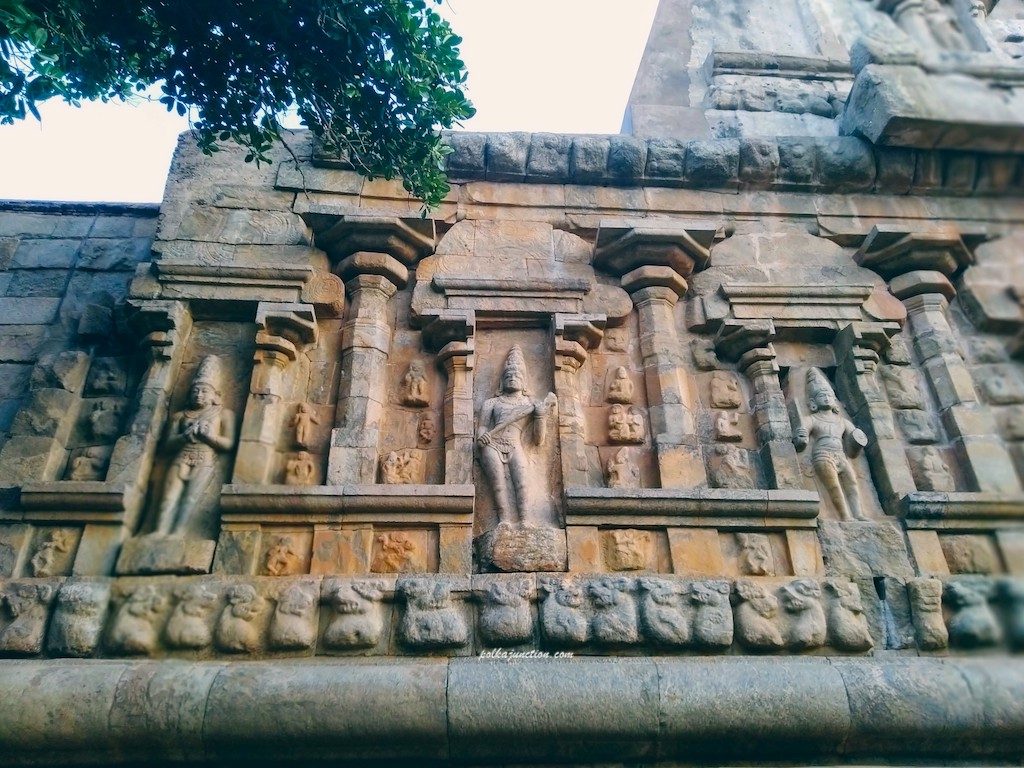
Must-See Chola Sculptures at Gangaikondacholisvaram
Although the sculptures of the gatekeepers with the anaconda are unique to the Chola architecture, the sculpture of Shiva wrapping a garland around the head of a kneeling saint Chandesha is one of the most popular images of the Gangaikondacholisvaram at Gangaikondacholapuram.
However, some archaeologists and historians believe that the sculpture actually symbolizes the coronation of Rajendra Chola while being blessed by Lord Shiva himself.
Since there is no consensus on this yet, the debate lingers on!

Another Chola sculpture that is a personal favourite of mine is the one that oozes calmness through all the chiselling that it has taken.

Here are some more Chola sculptures inside the premises of the Gangaikondacholapuram Brihadeeswarar temple to enthrall your eyes…


My thoughts on Gangaikondacholapuram and Rajendra Chola
I have read time and again on various blogs and sites, that Rajendra Chola wanted to compete with his father in building a bigger and better temple to reign supreme, but failed and subsequently accepted defeat.
Hence, the height of the vimana at Gangaikondacholapuram was reduced from what was proposed before.
I find this proposition really absurd.
Reasoning: Let us remember that the Gangaikondacholapuram temple was built within twenty years of the Big temple of Thanjavur. This means Rajendra Chola must have been in possession of at least a majority of the architects and sculptors if not all who could have replicated the architecture here too.
My conclusion is that Rajendra Chola wanted to dedicate a temple to show, that this universe requires feminity as much as masculinity to maintain a balance.
It is a known fact that the vimana of Gangaikondacholapuram temple looks elegant and is the feminine version unlike the masculine version of Thanjavur Big temple.
And, from historical records, we get to know that Rajendra Chola was raised by his aunt Kundhavai and great-grandmother Sembian Madevi who come across as strong female characters when reading Chola history.
Maybe, the temple was a tribute in his own way to these two ladies because his father too was highly influenced by Kundhavai.
Who knows, probably, there was a silent pact between the father-son duo to build masculine and feminine forms of Brihadeeswara temple.
And, that is the reason there are not many inscriptions on the temple walls unlike the ones seen at the Big temple of Thanjavur. Possible, isn’t it?

How India has forgotten historical characters like Rajendra Chola
Unfortunately, not many Indians are aware of Rajendra Chola [including me, until a few years back].
It is only when I started taking interest in the Cholas and read umpteen papers and listened to talks on Cholas as part of my research that I got to know about this once glorious dynasty of India.
Indian school history textbooks have never looked beyond the Mughals and the region of Vindhyas when it comes to ancient Indian historical events and kings. So do not be surprised if you meet an Indian who is unaware of the Chola emperors!
Thanks to the efforts of the Archaeological Survey of India in recent years, under the aegis of Dr. Nagaswamy, many of the Chola heritage sites have been renovated and brought to the fore.
The UNESCO Heritage tag has only further alleviated the cause and has helped in a speedy revival of the spectacular Chola art and architecture.
The year 2014 also marked the 1000 years of the coronation of Rajendra Chola (the most successful Chola emperor).
People of Gangaikonda Cholapuram and the surrounding villages held a huge rally starting from Maaligai Medu, the village from where the remains of the king’s palace have been excavated.


A glorious sunset at Gangai Konda Cholapuram
As we were leaving the premises of the UNESCO Heritage Site of Gangaikondacholapuram temple, I witnessed flocks of birds(pigeons) circumambulating (flying) around the vimana in a clockwise direction, exactly three times, as if in a trance and meditation and then occupying their homes nestled between the innumerable stucco work on the vimana!
Was this out of reverence to the almighty or just a coincidence!
Well, we may never be able to find answers for these surprises that nature, history, and spirituality throw at us.

Practical information on planning a visit to Gangaikondacholapuram
Here are some practical information and tips to plan your trip to Gangaikondacholapuram.
Gangaikondacholapuram Brihadeeswarar Temple timings
The Brihadeeswarar Temple at Gangaikondacholapuram is open throughout the week from 6:00 a.m to 12:00 a.m, and again from 4:00 p.m to 8:00 p.m.
There is no entry fee for Gangaikondacholisvaram.
Best Season to Visit Gangaikondacholapuram
If you cannot withstand heat then I would highly recommend you to visit southern India between the months of November-January.
Also, early mornings and evenings are the best times to visit the temples to avoid the everyday crowd.
The, same holds good with Gangaikondacholapuram.
Where to stay
There are no hotels, restaurants, or shelters available nearby to the Gangaikondacholapuram temple. So plan your trip accordingly.
Also, pack some food before embarking on a journey to Gangaikondacholapuram. There is just a kiosk that sells snacks outside the temple entrance.
You may opt to stay at some top-notch accommodations in Thanjavur, as well as Kumbakonam, which are bigger cities with a wide range of stay options.
Meanwhile, if you are planning a visit to Chidambaram from Gangaikondacholapuram, then do check these hotels to stay while in Chidambaram.
Alternatively, you could also consider staying at the below properties in both Kumbakonam and Thanjavur, which are offering some excellent deals.
Plan your trip to Brihadeeswarar temple
You can either cover Gangaikondacholapuram separately or club it with a trip to all the three Great Living Chola Temples, and a visit to Chidambaram.
If you are new to the state of Tamil Nadu, and planning a trip from Chennai, then I highly recommend you opt for the below LIVE guided tours, or audio guides, as it would really help to understand the importance and cultural significance of these temples.
Route map to reach Gangaikonda Cholapuram
The below map gives you the route from the airport at Tiruchirapalli and covers the Big temple at Thanjavur, Airavateeswara temple at Darasuram, Brihadeeswara temple at Gangaikondacholapuram as well as the Nataraja temple at Chidambaram.
I suggest you not hurry but make it a leisurely two-day trip with an overnight halt at Chidambaram.
Each of these temples will take at least a few hours to see around. And, if you are a photography and history enthusiast then keep aside some more hours!
How to reach Gangaikondacholapuram
Bus Route: There are ample buses plying from towns named Chidambaram, Thanjavur, and Kumbakonam towards Gangaikondacholapuram.
The nearest town is Kumbakonam which is around 30 kilometers from Gangaikondacholapuram.
Alternatively, you can also catch a bus plying towards Jayakondam to reach this place from Kumbakonam or Chidambaram.
Cabs: One can hire a cab from any of the above towns as well as Tiruchirapalli or Neyveli. We hired an Innova from Chidambaram and it costed us around Rs.3000/- for the round trip, but then we covered our ancestral village too!
Airport: The nearest airport is at Tiruchirapalli.
Also, I hope you enjoyed this guided virtual tour of Gangai Kondacholapuram, as much as I enjoyed putting it together!
Do leave your thoughts and valuable feedback in the comments below. Also, I expect this exhaustive guide comes handy in planning your trip to the elegant Brihadeeswarar temple and this part of India.

Pin this article for a later read!


This essay forms part of a larger exploration of Tamil Nadu’s sacred landscapes.
This was a fascinating read. I had no idea that Gangaikondacholapuram was built to commemorate a military campaign to the Ganges. The comparison of its architecture to the Thanjavur temple really helped visualize its unique, slightly curvilinear vimana. It’s incredible how much history is embedded in a single site.
Hi, Great article! Am unable to see any images on my windows laptop. Shows the links as broken. Can you please check? I would like to create a link to your blog to a site that I am creating, which has a section on Chola temples.
Works fine at my end. Thank you!
amazingggggg post. you did wonderful justice to the greatness of gangaikondachozhapuram sis! you’re great!
Thank you!
GKC my love!!! I was really young when my parents took me to GKC, Dharasuram and Thirubhuvanam…
Now, I’m hoping to go again, this time with my little gal. (Soon, she’s complain too that I took her when she was too young! lolz!).
Thanks for this detailed guide. This is one of the first 3 places (other 2 being Mahabalipuram & Kanchipuram) in TN that I want to take my daughter to! 🙂
I heard about this temple before but never realized it’s a part of the UNESCO Heritage list. The information you provided about the Dwarpalaks is fascinating. This will be one of the first places I’ll visit when I go back to India next year.
Gangaikondacholapuram Temple definitely looks elegant and beautiful. I love how detailed the sculptures, statues and the wall are. The guided tour of Nandi and Vinama look interesting. It’s useful that you include the transportation method for this temple.
What an incredible beautiful site. This temple – I won’t try to spell it out! – is really one of the reasons I’d love to visit India one day. The legends and tales surrounding the temple is equally interesting too. Vimana is really a work of art, and it definitely deserves its UNESCO title.
The temple looks magnificent! Its details including the walls, statues, and sculptures are very intricate. The things they found during the excavation are quite interesting. This is actually my first time to know about this UNESCO World Heritage Site and I learned a lot from your in-depth article and tidbits. 🙂
Gangaikondacholapuram Temple looks beautiful and I was truly delighted to learn about yet another UNESCO World Heritage Site from India 🙂 It is elegant indeed and a complete new discovery for me. Looking at the fantastic pictures, I would agree that it is magical enough to transport one to another era. I loved the guided tour here and can’t wait to see it when I visit Tamil Nadu next!
Such a great detailed post about the fascinating site. It must have been great to hear your father’s stories as you were travelling there, always makes it much more memorable when you have first-hand anecdotes. The history of the kings you included was very interesting and really bought the place to life.
You are right. The temple is symmetrical that made it elegant and it does look like a Shiva lingam. I also like that you could catch the sunlight on the Vimana with your camera. It’s beautiful! Reading through your history lesson about Rajendra Chola Dynasty that also conquered Sumatera in Indonesia, reminded me of a history lesson I learned back in middle school; more over after I saw a picture of the temple ruin. It reminded me of a temple ruin that looks the same, situated in Riau Province in Sumatera. So I guess it was from Chola Dynasty.
This is an amazing article about a great UNESCO site whose name i can’t pronounce 😀
As usual your pictures are fabulous and makes me want to drive up there right now. Thanks for refreshing the history lessons on Chola Dynasty which we read in school. Sad that they remain mostly neglected in pop culture compared to the Rajputs, Mughals and British colonists.
True… it is quite a difficult name for non-Tamilians to pronounce. It is quite sad that we haven’t seen beyond the mughals. I am yet to read about the Ahoms! Thanks for dropping by 🙂
The narration and the photographs were a treat, Meenakshi! Loved the detailed piece and the exquisite craftsmanship that you managed to capture on your camera so beautifully. Would definitely love to see it for real someday.
Oh wow, this temple looks insane. The gates to the temple at spectacular as well. This will definitely be a site that I need to add to my list of places to visit.
PS: The anaconda tidbit was so interesting!
Haha…Thank you so much,Corinne 🙂
Fantastic post, Meenakshi. I’m fascinated by the detailed sculpture that you managed to capture so brilliantly. This temple seems to exude peace, unlike some of the other busy religious places we see in India.
Yes, I was pleasantly surprised with the maintenance of all the three great living Chola temples.Thank you so much for reading !
What a detailed narration! And look at those images! Fabulous! Great job!
These images are magnificent… This is a superbly researched post on this. Don’t be surprised if it starts turning up on the first google search page for this temple soon.
Mesmerised by the beauty of this place Meenakshi, you have captured the essence of the heritage site so brilliantly. Thank you for sharing the details about the historical importance too.
I love the details and elegance in this temple. This is a well detailed post with lots of information. Thanks for sharing the history behind it.
Wow! The Nandi looks magnificent, I hv never seen such a beautiful and majestic one before. Keeping a note of this place, I have been to TN before but NVR heard about this place.
This is very interesting write up I came across . Loved the pictures and the piece of writing.
I love how symbolic and detailed all of the statues and carvings are. It took me a while to find that snake! Haha. I agree with what you said about family travels. It’s always more enriching to hear all of the little tidbits that come with bringing our parents and grandparents with us!
I agree- it does look very elegant but what a complicated name though!
Very interesting read. I was also totally unaware of the Chola kings. It is only when I started reading a translation of Ponniyin Selvan, I delved deeper to understand this dynasty. The temple looks so beautiful and the pictures are amazing. Already added this location to my must visit list.
Such a detailed and exhaustive post Meenu. Of course, studded with your stunning captures. I loved the information about the Dwarpalaks, so symbolic and interesting. Glad you could visit on a Monday.
Pencilling in this for a future visit.